

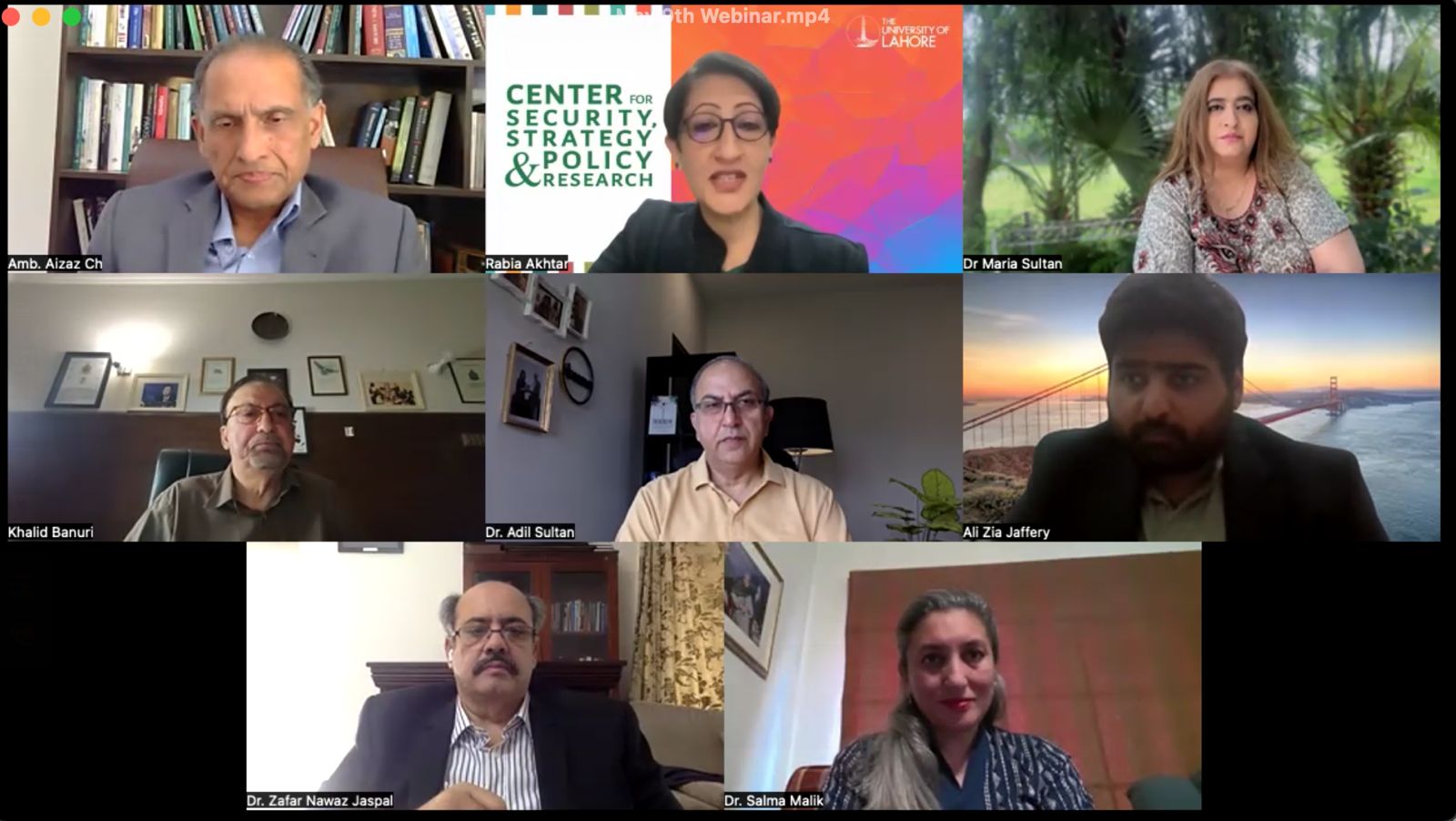
The Center for Security, Strategy and Policy Research (CSSPR) at the University of Lahore organized a high-level webinar titled “Deterrence to Diplomacy: Pakistan’s Strategic Repositioning” to commemorate the first anniversary of the May 2025 conflict, widely referred to in Pakistan as Marka-e-Haq.
Moderated by Dr. Rabia Akhtar, Director CSSPR, the webinar brought together distinguished experts including Ambassador Aizaz Ahmad Chaudhry, Dr. Adil Sultan, Dr. Zafar Nawaz Jaspal, Dr. Maria Sultan, Air Commodore (R) Khalid Banuri, Dr. Salma Malik, and Sayed Ali Zia Jaffery to assess the conflict’s long-term implications for deterrence, military preparedness, diplomacy, and regional stability.
Panelists described May 2025 as a turning point in Pakistan’s strategic posture, arguing that the crisis challenged assumptions about India’s unilateral escalation dominance and restored deterrence equilibrium. Speakers highlighted Pakistan’s conventional military preparedness, integrated air and electronic warfare capabilities, and the growing importance of emerging technologies, including AI, drones, cyber, and space systems in future conflicts.
On the diplomatic front, panelists noted that Pakistan emerged with greater strategic confidence and regional relevance following the crisis. Discussions emphasized shifting regional alignments, Pakistan’s expanding role as a stability provider, and the importance of narrative resilience amid disinformation and geopolitical contestation.
Experts also cautioned against complacency, warning that India is likely to pursue accelerated military and technological recalibration. A consensus emerged that Pakistan’s long-term strategic gains can only be sustained through economic resilience, institutional strength, technological innovation, and human capital development.
The webinar concluded that Marka-e-Haq reshaped strategic perceptions in South Asia and underscored the need for responsible statecraft and forward-looking preparedness in an evolving regional security environment.
