

Students in Pakistan scored an average of 38 per
cent in mathematics and 47 per cent in science in a nationwide study presented at
the Aga Khan University (AKU), with researchers saying the results show the need to
strengthen classroom teaching and teachers’ professional development.
The Science and Mathematics Instruction and Learning Outcomes study was
presented by AKU’s Institute for Educational Development (IED) alongside research
partners at the closing ceremony of the Data and Research in Education – Research
Consortium (DARE-RC), a three-and-a-half-year national research programme
funded by UK International Development. Within 44 other discussion and scoping
papers, attention was given to the educational exclusion of religious minority
students, barriers that children with disabilities face in mainstream schools,
strengthening frontline teaching, and the opportunities and quality problems that
come with public-private partnerships in education.
The test scores reflect learning among children who are in school. Some 25 million
children in Pakistan are out of school altogether, according to the federal education
ministry’s Pakistan Education Statistics Report 2023-24, released in April 2025.
“DARE-RC was a rare project where scholars were encouraged to come up with
their own ideas for research. That is one of its great strengths which one hopes will
be emulated widely.” said Dr Farid Panjwani, Dean of IED. “As the consortium
concludes, the launch of the Dean’s Forum opens a path for academic research to
stay connected to national reform priorities, and to help shape where those priorities
go next.”
Policymakers, researchers, education leaders and development partners attended
the ceremony, which reviewed the consortium’s work and how its findings could be
turned into policy and classroom practice.
To carry the work forward after the consortium ends, a Dean’s Forum has been set
up as a national platform that brings together Deans and Heads of Departments of
Education from universities across Pakistan to continue research-informed policy
dialogue, work together and advance shared priorities for education reform.
Led by Oxford Policy Management in partnership with AKU’s IED and Sightsavers
International, DARE-RC brought national and international researchers together to
innovate homegrown solutions that work, and urge local policy makers while also
reaching out to the global education policy landscape through scholarly publications.
It also involves two cross-cutting themes ‘effective data use’ and ‘scalable solutions’
that aim to ensure rigour and impact of the research across all four priority areas.
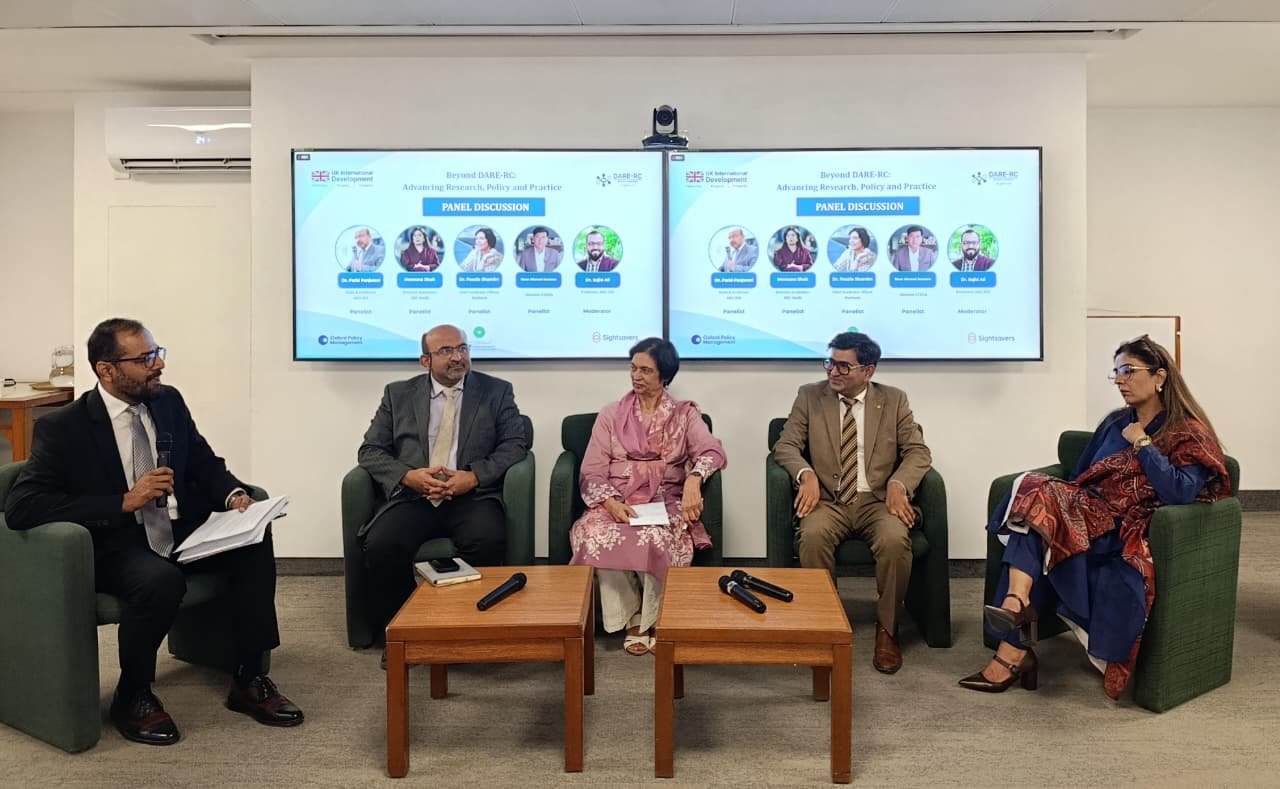
A panel discussion, Sustaining Research Impact Beyond DARE-RC, moderated by
Dr Sajid Ali, featured Dr Farid Panjwani and Dr Dilshad Ashraf of AKU-IED, Prem
Sagar of Ministry of Education, and Memona Shah of the Sindh Higher Education
Commission and Dr Fauzia Shamim of Durbeen. Panellists explored pathways to
accelerate policy uptake, strengthen institutional ownership, and ensure the long-
term sustainability of research-informed reforms.
A Research Gallery Walk alongside the sessions displayed DARE-RC studies on
climate-resilient schooling, education data governance and standards for frontline teaching.
