

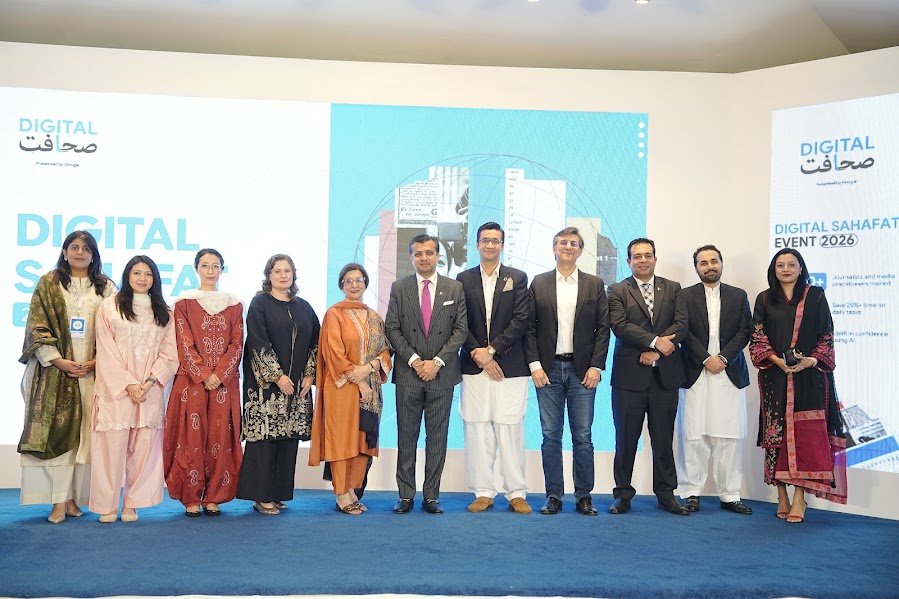
Google celebrated two years of Digital Sahafat at an event held at the Pearl Continental Hotel in Lahore. Digital Sahafat trained Pakistani journalists
and journalism students to use Google AI tools to verify information, work more efficiently and
build sustainable newsroom practices. The event marked the program’s progress since 2024
and its expansion into Balochistan and Khyber Pakhtunkhwa.
The event was attended by Ali Dar, Advisor to the Chief Minister of Punjab on AI, International
Cooperations and Special Initiatives, and media industry leaders such as Sultana Siddiqui,
Founder & Chairperson, Hum Network. They were joined by representatives from the Google
team including Kate Beddoe, Managing Director, News Partnerships, APAC. Policymakers,
senior journalists, media executives and program participants were also present at the event.
“No government can do this alone. It takes Google, Tech Valley, our universities, and our media
houses working together. That to me is what future-forward Pakistan means,” said Ali Dar,
Advisor to The Chief Minister of Punjab on AI, International Cooperation and Special Initiatives.
Empowering Pakistan’s newsrooms in the AI era
As we enter the AI era, Pakistani journalists have a unique opportunity to elevate their
storytelling and strengthen the verification of online content. To support journalists with hands-
on access to the latest AI tools and training, Google launched Digital Sahafat in September
2024.
Through a cascade training model, Tech Valley—an ed-tech social enterprise—Digital Sahafat
empowers Master Trainers to instruct journalists, media practitioners, and students nationwide. The
initiative has been delivered in collaboration with prominent media partners, government bodies
(including the Higher Education Department of Punjab, the Science and IT Department of Sindh, and
the Information Departments of Balochistan and Sindh), and leading universities such as
Beaconhouse National University, International Islamic University Islamabad, Sindh Madressatul
Islam University, Bahria University, and the University of Karachi.
Impact since 2024: More than 4,000 journalists trained
across four provinces Since 2024, Digital Sahafat has trained over 4,000 journalists, journalism students, and media practitioners, and more than 60 Master Trainers across Punjab, Sindh, Balochistan and Khyber
Pakhtunkhwa. Findings from the program’s 2025 participant surveys showed that:
● 85% of participants now use Google AI tools in their daily work.
● Nearly 68% of participants saved more than 25% of their time on daily tasks.
● Participants reported a 260% uplift in confidence using AI.
“I am proud to celebrate the impact of Digital Sahafat. Seeing first hand how journalists across
Pakistan have not only adopted AI, but embraced it is inspiring our work with the news industry
across the Asia Pacific region,” said Kate Beddoe, Managing Director, News Partnerships,
APAC, Google.
Part of Google’s wider support for journalism
Google has partnered with the news industry for more than 20 years, and continues to do so as
we explore new shared opportunities for publishers and consumers. We show up for the global
news ecosystem in many ways, including through training programs covering the latest in
Google technology. Across 120 countries, we have trained 2.5 million journalists and industry
professionals. Digital Sahafat is part of this effort to work with journalists and provide resources
and training to navigate the ever-changing digital landscape more effectively. Through the
program, Google aims to strengthen digital innovation, media literacy and the role of journalism
in society.
