

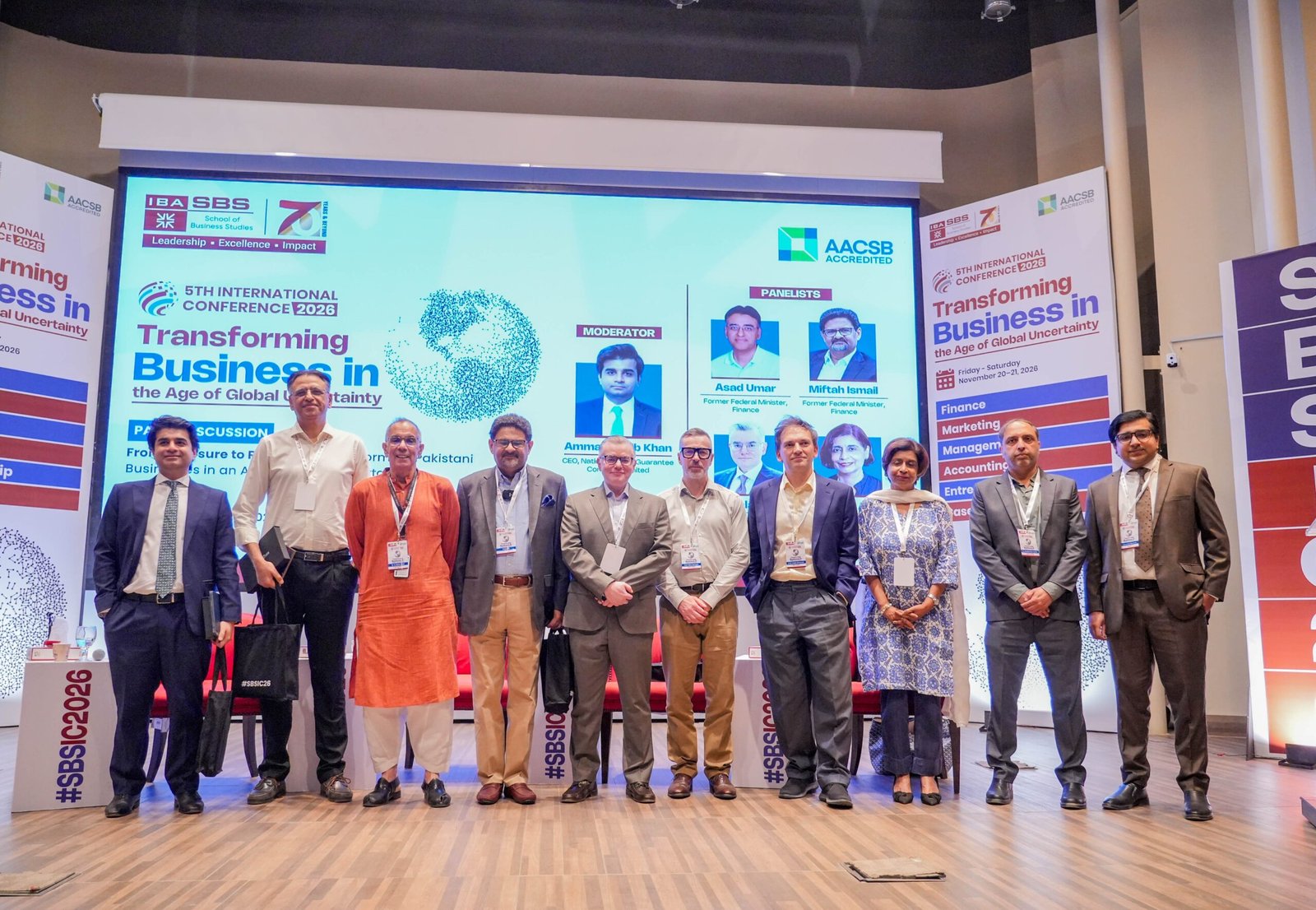
IBA proudly hosted the Fifth International Conference on “Transforming Business in
the Age of Global Uncertainty”, which was organized by its School of Business Studies (SBS) at the Main
Campus. The two-day conference has brought together academics, policymakers, business leaders and
researchers to examine responses to economic volatility, technological disruption and changing global
dynamics.
Dr. S Akbar Zaidi, Executive Director, IBA Karachi, in his welcome remarks, spoke about Pakistan’s persistent
political and economic uncertainty. He cautioned that resilience in the face of repeated crises should not
become a substitute for meaningful progress. Reflecting on shifts in globalization and the growing influence of
emerging and middle powers, he called for a transformation that strengthens Pakistan’s ability to prosper
rather than merely withstand disruption.
Dr. Abdullah Zafar Sheikh, Professor & Dean, SBS & Conference Chair, welcomed the participants and reflected
on the growing influence of artificial intelligence on businesses, jobs and education. Rather than viewing AI
simply as a source of cognitive dependence, he emphasized new ways of learning and navigating uncertainty.
He underscored the responsibility of business schools to nurture judgment, critical thinking and sound decision-
making among future leaders.
The opening keynote was delivered by Prof. Marc Goergen, Full Professor of Finance, IE Business School, IE
University, Madrid, Spain. He presented research-based insights into corporate governance and meta-analytical
evidence on how boards, directors, and governance structures shape organizational outcomes.
The panel discussion, “From Exposure to Resilience: Transforming Pakistani Businesses in an Age of Global
Uncertainty,” was moderated by Ammar Habib Khan, CEO, National Credit Guarantee Company Limited, and
featured Asad Umar and Miftah Ismail, Former Finance Ministers of Pakistan; Adil Salahuddin, CEO, Standard
Chartered Pakistan, and Nausheen Ahmad, Independent Director, Meezan Bank Ltd. Miftah Ismail said high
business costs and low savings and investment limit Pakistan’s competitiveness as AI reshapes global industries.
Adil Salahuddin called for stronger private-sector financing and capital markets, along with financial innovation
and vocational skills. Asad Umar urged affordable digital infrastructure, integrated government databases and a
shift away from a control-oriented mindset. Nausheen Ahmad noted that complex compliance and weak
governance deter firms from scaling, stressing transparency and an enabling environment for entrepreneurs.
In the second keynote, Prof. Vadim Grinevich, Professor of Entrepreneurship and Innovation, University of
Bradford School of Management, UK, explored transformative entrepreneurship, highlighting the importance of
entrepreneurs and innovation in responding to societal and economic challenges.
The conference program also featured parallel technical sessions and research presentations across
management, finance, marketing, accounting, entrepreneurship, and case studies, reinforcing SBS’s
commitment to research-led dialogue and business transformation. The conference drew strong participation
from faculty members, researchers, and students from universities across Pakistan. Participants engaged
actively with the keynote speakers and panelists during question-and-answer sessions, sharing perspectives on
Pakistan’s economic challenges, emerging technologies and the future of business.
