

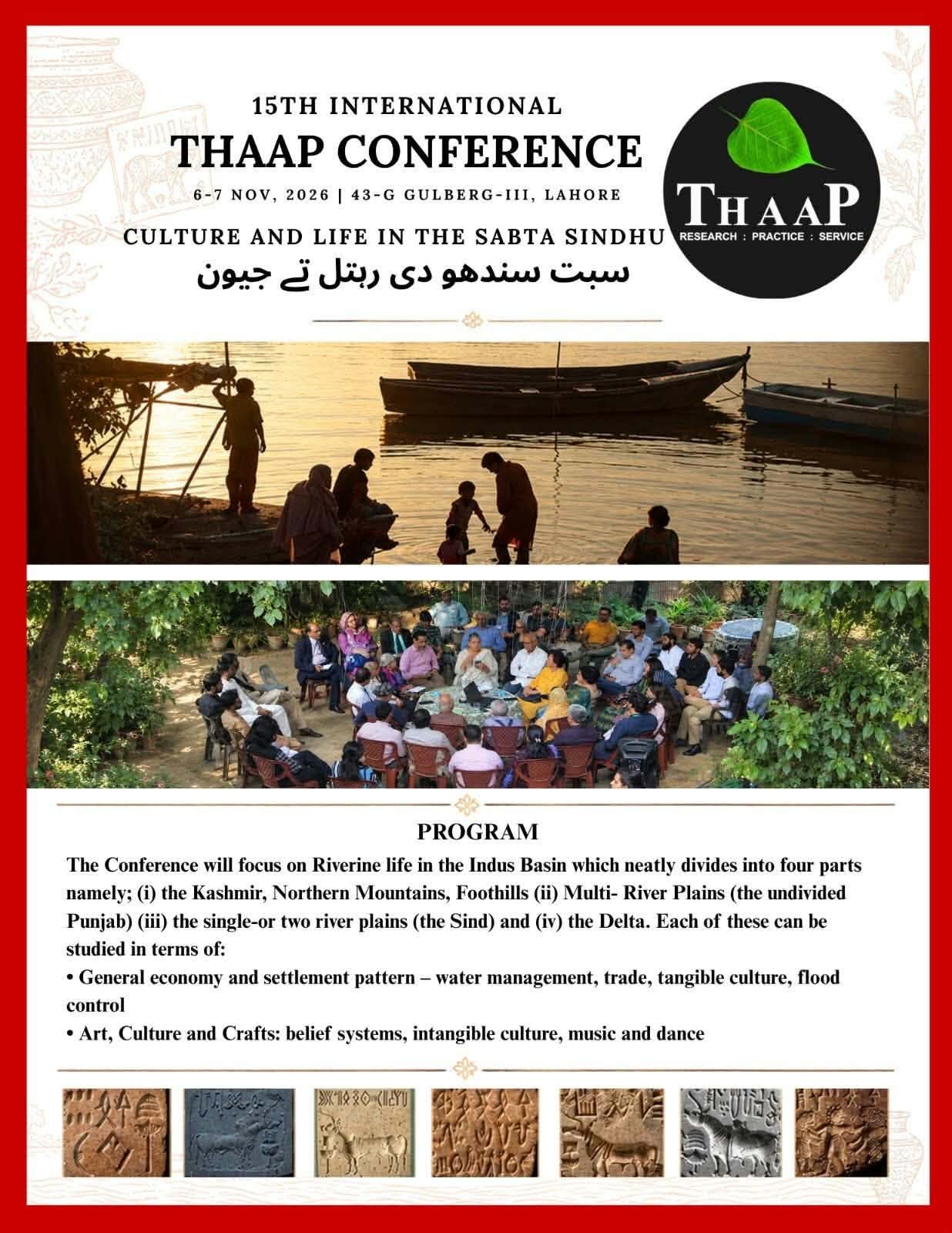
From ancient writing systems and the Ravi River’s historic trade routes to Phulkari, traditional jewellery and folk songs, the 15th International THAAP Conference will explore the diverse cultural and historical heritage of the Indus Basin. Delegates and researchers from across the country are arriving in Lahore as preparations for the two-day event enter their final stages.
Scheduled for November 6–7 at 43-G, Gulberg-III, Lahore, the conference, titled “Culture and Life in the Sabta Sindhu” (سبت سندھ دی رہتل تے جیون), will feature 25 research papers across seven sessions, examining the region’s civilisational history, cultural expressions, indigenous knowledge and traditions.
Over the years, the THAAP Conference has earned recognition in academic and literary circles as a platform for original research, scholarly exchange and intellectual discourse, attracting researchers to present their work.
The programme examines the Indus Basin as an interconnected cultural landscape shaped by rivers, communities, settlements and systems of knowledge. Its geographical scope encompasses Kashmir, the northern mountains and foothills, the multi-river plains of undivided Punjab, the plains of Sindh and the Indus Delta.
The research papers cover diverse subjects, including comparative studies of early writing systems of the Harappan, Egyptian and Mesopotamian civilisations, the Ravi River’s historical role as a trade route, the pastoral society of Sandal Bar before British canal colonisation, and Lahore’s history through its epigraphic and archaeological heritage.
Other papers explore Punjabi folk songs and architecture, Phulkari as an emotional archive, traditional jewellery in the Sapta Sindhu, storytelling through Indus seals and the representation of women in ancient Harappan culture. Further topics include river cultures, traditional crafts, disaster memory, indigenous knowledge and the continuity of cultural traditions.
Prof. Sajida Haider Vandal, CEO THAAP, and Pervaiz Vandal, conference convener, are overseeing the preparations, bringing their personal commitment and resources to advance the conference’s aims of promoting knowledge, cultural restoration and indigenous folk traditions.
The inaugural session on November 6 will feature a keynote address by Prof. Dr. Noman Ahmed, Pro Vice Chancellor of NED University of Engineering and Technology, Karachi. Prof. Dr. Raheel Qamar, Rector of COMSATS University Islamabad, will attend as chief guest.
Through its annual international conferences, THAAP continues to promote research and dialogue on the region’s historical, artistic and cultural heritage, fostering a deeper understanding of the traditions and knowledge that have shaped life in the Indus Basin across generations.
