





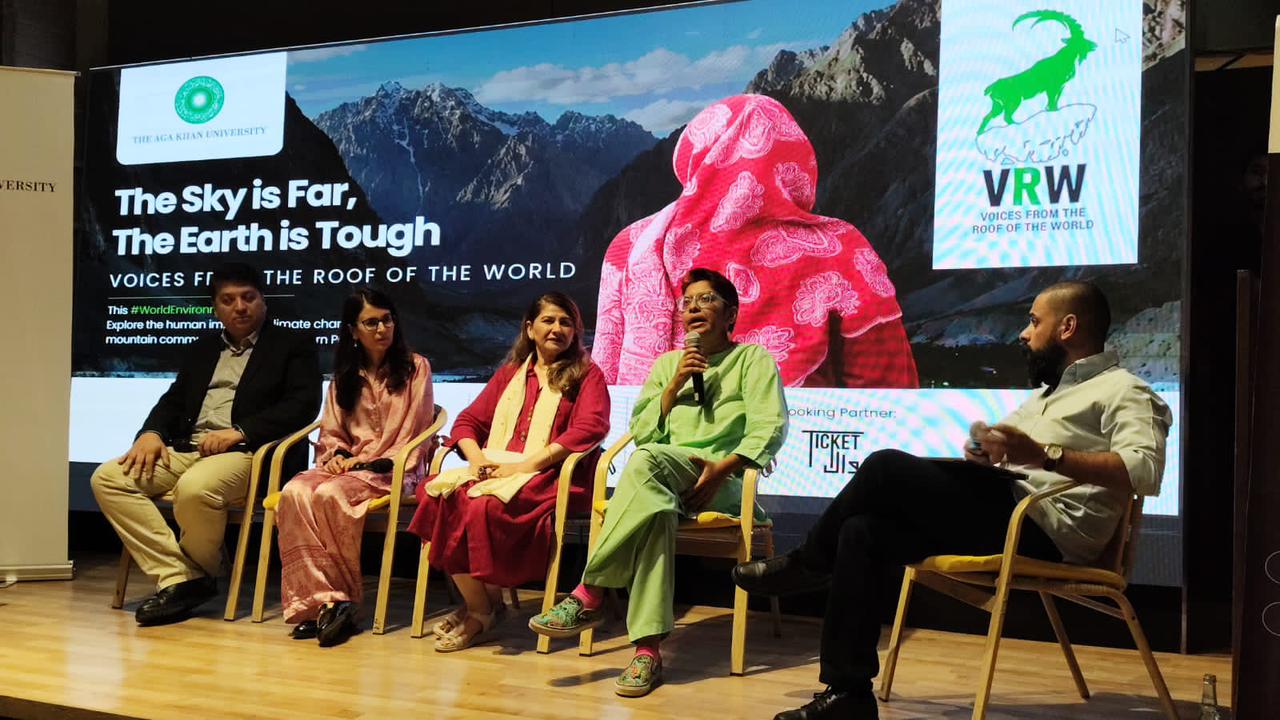
To mark World Environment Day, Aga Khan University (AKU) hosted a public documentary screening of “The Sky is Far, The Earth is Tough,” directed by Haya Fatima Iqbal, at Habitt City. Part of the Voices from the Roof of the World (VRW) documentary series, the film explores how natural disasters and climate change are affecting the physical health and mental well-being of mountain communities in Northern Pakistan.
The film offered an unvarnished look at the resilience and vulnerabilities of these northern communities and brought together filmmakers, climate advocates, students, and change makers from different spaces to address the urgent environmental crises facing vulnerable populations.
Discussions with experts and filmmakers following the screening, highlighted how the mountain regions had been warming at significantly higher rates than the global average, accelerating glacial melt, triggering catastrophic flash floods, and caused unpredictable landslides. These changes had not only disrupted essential infrastructure but had also induced prolonged displacement and economic instability, creating an ongoing humanitarian and mental health crisis among indigenous communities who have contributed the least to global emissions.
“The climate crisis in our northern regions is no longer a distant threat; it is an active humanitarian challenge that demands immediate attention. We must integrate mental health into climate disaster response,” said Dr Rozina Karmaliani Associate Director, South and Central Asia, Brain and Mind Institute, addressing the audience. “Through Voices from the Roof of the World, our goal is to bring the raw, lived realities of these mountain communities to the forefront of dialogue. Visual storytelling always see past the numbers and helps understand the true human cost and the immense resilience of those living on the frontlines of environmental collapse.”
“Integrating climate change awareness into our educational framework is vital if we want to build lasting community resilience,” said Dr Fozia Parveen, Assistant Professor at AKU’s Faculty of Arts and Sciences. “The focus must center on equipping the next generation with environmental sustainability education, enabling them to understand, adapt to, and advocate against the climate realities rapidly disrupting vulnerable regions.”
The loss of ancestral lands and the constant threat of natural disasters inflict a deep, often unrecorded trauma on these populations, said Haya Fatima Iqbal, Academy and two-time Emmy winner, adding “environmental advocacy must evolve beyond regional statistics to address the profound human cost and the psychological scars left in the wake of environmental collapse.”
Tariq Essa, sustainability and climate change specialist emphasized on what role businesses and individuals can play to reduce the carbon footprint. As climate-related challenges intensify globally, initiatives that bring together media and experts are becoming increasingly important in shaping informed public discourse.
The screening was sponsored by Primero. VRW is an award-winning documentary series that amplifies voices from climate-vulnerable communities in Central and South Asia facing floods, droughts, and biodiversity loss. The series is a joint initiative of the Aga Khan University, the Aga Khan Agency for Habitat, the Aga Khan Foundation, and the University of Central Asia — made possible with support from Ross Beaty, the Sitka Foundation, Gulshan Kassamali Jiwa Family, Prince Sadruddin Aga Khan Fund for the Environment, and the Jenabai Hussainali Shariff Family. The project is dedicated to producing high-impact environmental journalism and documentary storytelling to raise global awareness about the ecological crises facing vulnerable populations on the frontlines of climate change.


