







Mini LED has become one of the talked-about terms in television marketing. It shows up on TVs at all price points, from expensive flagship models to much more affordable options. Yet you can find the words on boxes that cost three times as much as each other. So what is it, actually, and why does it matter for the picture you end up watching?
At its core, Mini LED uses significantly smaller LED chips than those found in conventional LCD TV backlights. Because each chip is so much smaller, manufacturers can pack thousands more of them behind the same screen, arranged far more densely than a standard LCD TV ever allowed.
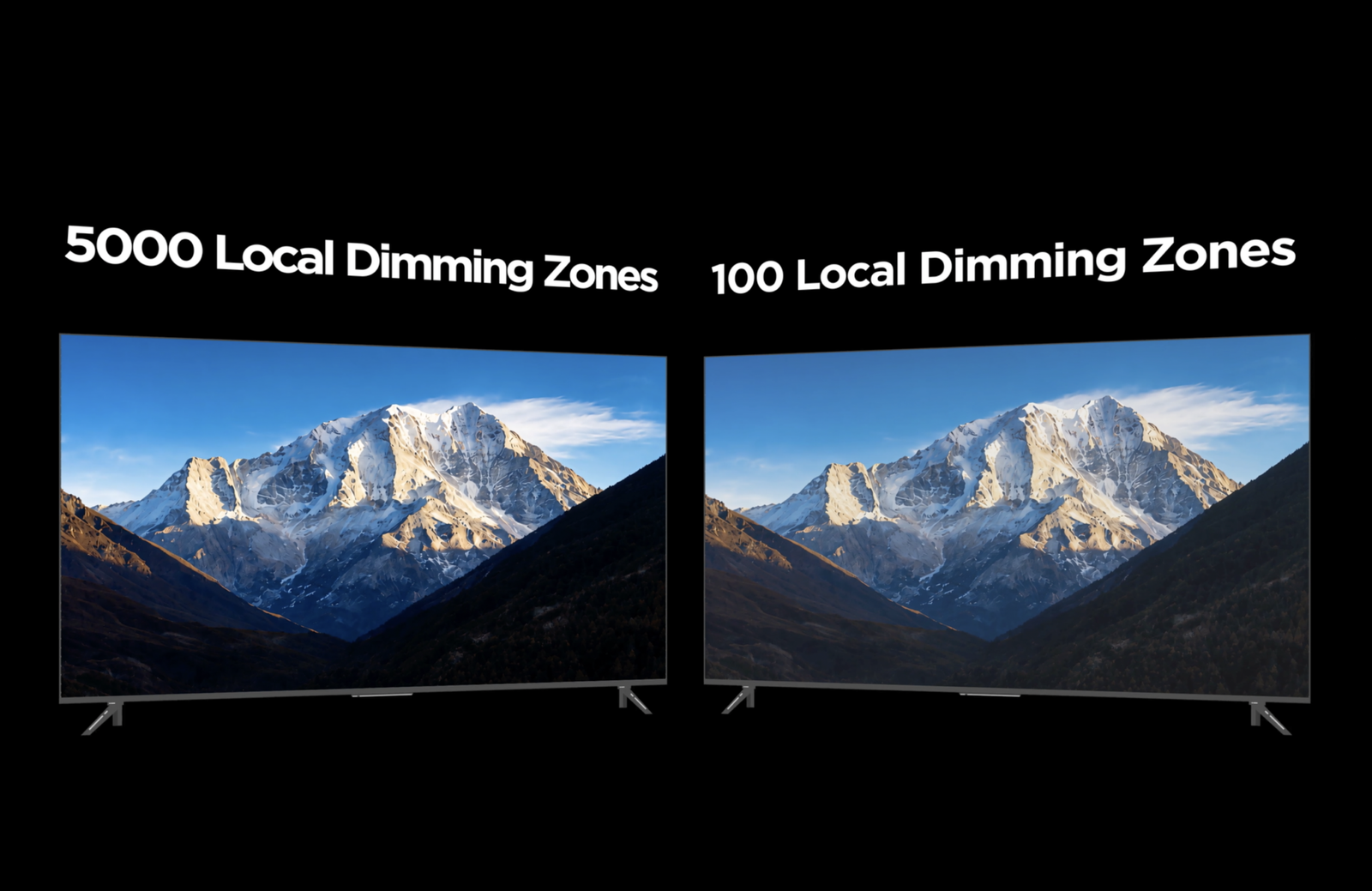
That density is what makes the technology worth paying attention to. More LEDs mean the backlight can be divided into many more independently controlled zones, small clusters of light that can be brightened or dimmed on their own, rather than the entire screen lighting up or dimming as a single block. When done properly, this leads to deeper blacks, brighter highlights, and far more visible detail in scenes that mix light and shadow. The kind of contrast that not long ago was only possible with much more expensive display technologies.
That’s the idea. It doesn’t tell you how many are used, how they’re arranged, or how intelligently their brightness is actually controlled. Two televisions can legitimately carry the same label and still produce very different pictures once they’re placed side by side. What makes one better than the other depends on three things worth checking before you buy, whatever the brand.
1. Hardware Dimming: Is the Backlight Actually Being Controlled?
Mini LED performance depends on hardware-based local dimming, where the brightness of physical LED clusters behind the screen is independently controlled across different zones. Software-based, or “virtual,” dimming relies primarily on image processing rather than independent hardware control of physical backlight zones. Under comparable conditions, this can provide less precise control of bright and dark areas, potentially resulting in more light leakage and lower perceived contrast. Hardware local dimming, by contrast, allows the backlight itself to respond to what is happening on screen. A bright object against a dark background, for example, can be illuminated without requiring the entire screen to brighten at the same time.
The distinction matters because Mini LED is ultimately a backlight technology. The more directly the hardware can control where light is produced, the more precisely the television can manage contrast.
2. Dimming Zones: How Precisely Can the TV Control Light?
The number of independently controlled dimming zones is another important factor in determining how precisely a television can separate light from shadow. A few hundred zones can make a real difference in contrast and brightness compared to regular LCD backlights. Under comparable conditions, more independently controlled zones allow finer separation of bright and dark areas, so panels with several thousand zones can offer more precise backlight control than designs with far fewer zones.
3. Backlight Architecture: Full Array Matters
How the LEDs are arranged behind the panel is another fundamental part of the equation. Edge-lit designs place LEDs around the perimeter of the screen and generally offer less localized backlight control than a full-array local-dimming architecture. Direct-lit designs place LEDs behind the panel but typically switch the backlight on or off as a single block rather than controlling it zone by zone. Full Array Local Dimming (FALD), with LEDs distributed across the entire back of the panel and each zone independently controlled, is the architecture behind genuine Mini LED performance and underpins TCL’s Mini LED range, from entry-level models through to the flagship line.
“Mini LED gets talked about as if it’s a single technology, but it’s really a family of approaches with very different results,” said Mr. Majid Khan Niazi, Director of Marketing, TCL Middle East, Africa & Beyond. “The three things that actually decide the outcome — hardware versus software dimming, zone count, and backlight architecture — are things any shopper can ask about, for any brand, before they buy.”
The distinction is becoming increasingly relevant as Mini LED moves further into the mainstream. According to Omdia’s global Mini LED TV shipment data by brand for the first half of 2026, TCL led the global market by Mini LED TV shipment volume, shipping 2.43 million Mini LED TVs worldwide, a 77.1 percent increase over the previous year.
As more televisions carry the Mini LED name, however, the name itself tells only part of the story. The real difference lies beneath the screen, in the number of zones, the way they are controlled and the architecture that puts them to work.
For consumers, those are the details worth asking about. For TCL, they represent the foundation of its Mini LED approach: because when it comes to picture quality, what is behind the label is what ultimately appears on the screen.


