







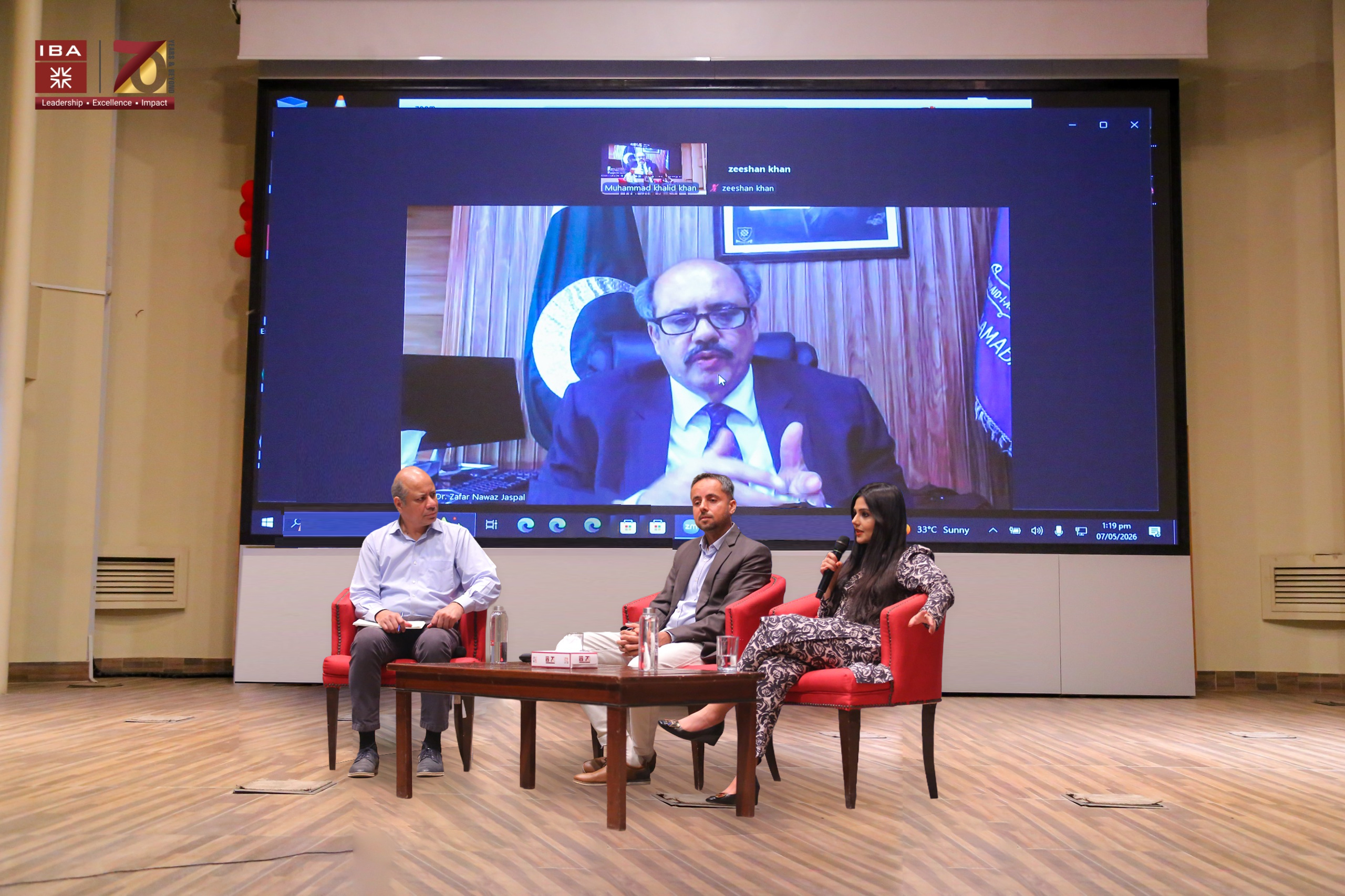
IBA hosted a thought-provoking panel discussion titled, “Wars, Crisis, and Deterrence Stability in South and West Asia”, organized by the School of Economics & Social Sciences (IBA-SESS) at the Main Campus. The session brought together leading voices to examine the evolving nature of conflict, deterrence, international law, and regional security in an increasingly unstable global environment.
The panel featured Professor Dr. Zafar Nawaz Jaspal, Interim Vice Chancellor & Meritorious Professor, Quaid-i-Azam University, Islamabad, who joined the session online; Ms. Reema Omer, Lawyer & Human Rights Professional, and Dr. Sajjad Ahmed, Assistant Professor, Department of Social Sciences and Liberal Arts, IBA. The session was moderated by Dr. Farhan Hanif Siddiqi, Professor & Chairperson, Department of Social Sciences and Liberal Arts, IBA.
Opening the discussion, Dr. Siddiqi framed the conversation around recent wars and militarized crises in the international system, including the Russia-Ukraine conflict, the ongoing crisis in Gaza, tensions between Iran and Israel, and the recurring pattern of escalation in South Asia. Prof. Dr. Jaspal discussed the concept of the “Fourth Nuclear Age,” emphasizing that the global strategic environment is increasingly marked by state-to-state conflict, the renewed centrality of military power, and the weakening of nuclear arms control frameworks. Ms. Omer discussed the legality of contemporary wars under international law, emphasizing that despite its selective application, international law remains vital for accountability, particularly for the Global South. She also highlighted key principles related to the use of force, self-defense, and international navigation.
Dr. Ahmed offered insights into Iran’s foreign policy, domestic resilience, and strategic outlook. He discussed how Iran’s historical experience, sanctions environment, and national security concerns have shaped its regional posture. He also reflected on Iran’s approach to sovereignty, resistance to external domination, and the relationship between domestic pressures and foreign policy behavior.
The discussion also explored India-Pakistan relations, deterrence by denial, the risks of future escalation, and the implications of military technologies, missile systems, drones, cyber operations, and multi-domain warfare for crisis stability. The session concluded with an interactive Q&A segment, allowing students, faculty, and attendees to engage with the panelists.


